Planning a trip or a school project? The capital of Baden-Wuerttemberg is Stuttgart, home to around 613,000 people and the state’s largest city. This short profile gives you the key facts.
This profile is part of the baden-wuerttemberg guide, which covers the state as a whole.
| Item | Value |
|---|---|
| Population of Stuttgart (state portal figure) | around 613,000 people |
| Rank within the state | largest city in Baden-Württemberg |
| Highest and lowest point of the urban area | 549 m and 207 m above sea level |
| Companies based in the city | over 29,000 |
| People employed in the city (2022) | around 538,000 |
The figures come from the Baden-Württemberg state portal and the city of Stuttgart’s statistics page. Statistics change over time, so check the source before you rely on them.
What does it mean that Stuttgart is the state capital?
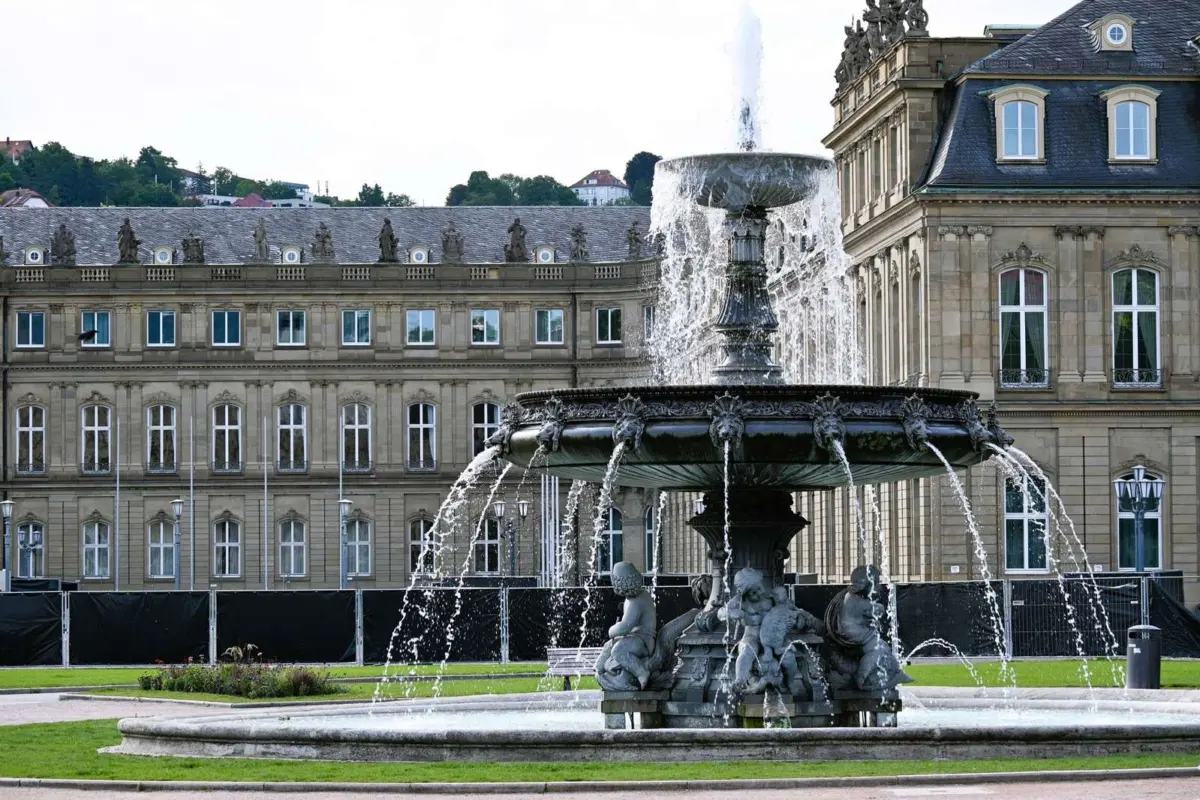
The state portal says that Stuttgart is the State Capital and, with a population of around 613,000, also the biggest city in the state. You can read this on the Baden-Württemberg state portal.
The city’s own statistics page calls Stuttgart the capital of the state and says it is one of the ten largest cities in Germany. That page, dated 8 October 2026, speaks of more than 600,000 inhabitants (Stuttgart in numbers).
Why do two figures appear? The city uses the municipal population register for its own numbers, while the official figures of the State Statistical Offices should generally be used when you compare municipalities. For a quick profile, “around 600,000 or a little more” is a safe description.
Size, people and landscape
Stuttgart is described by the city as a young and diverse place. Its statistics page gives a few demographic markers:
- An average age of just over 42 years.
- A share of people with a migration background of around 48 percent.
- Around 250 congregations, churches and faith communities.
Religion has shifted over time. According to the same city page, Stuttgart developed from a Protestant city into a city of religious diversity. Today less than half of residents belong to the Protestant or Roman Catholic churches, around ten percent are Muslim, and a quarter describe themselves as non-religious.
The setting is hilly. The highest point of the urban area lies 549 meters above sea level and the lowest 207 meters, and almost half of the city area consists of forests, fields and parks, as the city’s statistics note. The climate is temperate, with warm summers and cold winters.
Economy and work in the capital
The city describes itself as one of the most important economic centers in Europe, with strengths in the automotive and mechanical engineering sectors. These economic figures come from the city’s statistics page:
- Around 538,000 people were employed in Stuttgart in 2022, almost 15 percent of them in manufacturing.
- Over 29,000 companies are based in the city, and in 2022 they generated a turnover of over 308 billion euros.
- The gross value added was 53,144 million euros in 2022, which is just over 10 percent of the value added in the state.
Stuttgart is also a city of commuters. In 2023, over 60 percent of employees subject to social insurance contributions came to work from outside the city, while over 101,000 employees living in Stuttgart worked outside it, according to the statistics page.
The workforce is highly qualified: over a third of employees have an academic education, compared with a national average of just 22 percent. The same page lists 20,750 unemployed people against 4,630 vacancies as of December 2024, a snapshot of the labour market that will have moved since then.
A city of science and universities
The city’s German-language page on Stuttgart as a science city describes it as the scientific center of the state. Per that page, dated 5 October 2026, Stuttgart is the only city in Baden-Württemberg with two universities, plus five public Hochschulen and many private ones (stuttgart.de, Wissenschaftsstadt).
The two universities are the Universität Stuttgart and the Universität Hohenheim. With about 60,000 students, the same page calls Stuttgart the largest student city in the state.
The page also cites the State Statistical Office for the claim that 45 percent of the state’s research and development capacity is concentrated in Stuttgart. It adds that the city hosts more than 100 Steinbeis institutes, and names research institutes such as the Max-Planck-Institut für intelligente Systeme and several Fraunhofer institutes.
Science and business reinforce each other, the city says, which explains the strengths it lists:
- Mobility and automotive.
- Mechanical engineering and laser technology.
- New materials, aerospace, and environmental and energy technology.
- Software development, IT and communication technologies.
Where the capital sits within Baden-Wuerttemberg
Baden-Württemberg is the third biggest German state by area and by population. According to the state portal, an area of 35,751 square kilometres supports a population of around 10.8 million people.
After Stuttgart, the next largest cities in the state are Mannheim, Karlsruhe and Freiburg. If you want to compare them, the page on the cities in baden-wuerttemberg is a good next step.
Geographically, the state lies in Germany’s Southwest corner. According to the state portal, it neighbours three other German states and shares borders with three European countries, which puts it at the very heart of Europe.
Alongside its urban conurbations, the state describes itself as predominantly rural. The biggest rivers are the Rhine, the Neckar and the Danube, and Lake Constance covers 572 square kilometres, which makes it one of the world’s biggest freshwater lakes (state portal).
The same portal describes diverse landscapes across the state:
- In the west, the Black Forest and the Rhine Plain.
- In the south, Lake Constance and the ridge of the Alps.
- In the east, the Swabian Alb hills.
- In the north, the Hohenlohe plain and the uplands of the Kraichgau region.
This variety is part of what the state calls its unique character, and the capital is one piece of it rather than the whole picture. Reading Stuttgart’s profile next to these regions helps you place the city within the wider map of the southwest.
The state beyond its capital is largely green and rural. Forest makes up around 40 per cent of its total area, and the highest mountain is the Feldberg in the Southern Black Forest at 1,493 metres, as the state portal explains. Compared with that peak, Stuttgart’s highest point of 549 meters is modest.
To see how the state itself came together, read the history of baden-wuerttemberg.
Frequently asked questions
What is the capital of Baden-Württemberg?
Show answer
The capital is Stuttgart, according to the state portal. It is also the biggest city in the state.
How many people live in Stuttgart?
Show answer
The state portal gives around 613,000, while the city speaks of more than 600,000 inhabitants (Stuttgart in numbers). The difference comes from the sources and methods, so always name the source when you quote a figure.
Which cities come after Stuttgart in size?
Show answer
The state portal lists Mannheim, Karlsruhe and Freiburg as the next in size (state portal).
Is Stuttgart a student city?
Show answer
Yes. Per the city’s page dated 5 October 2026, it has about 60,000 students and is the largest student city in Baden-Württemberg (stuttgart.de, Wissenschaftsstadt).