Planning a Baden-Baden spa visit and unsure where to start? Two public thermal baths, fed by 12 hot springs, cover most needs: historic Friedrichsbad and modern Caracalla Therme.
If you are mapping a longer trip, the southwest germany travel guide shows where Baden-Baden fits in the region.
| Item | Value |
|---|---|
| Thermal springs | 12 artesian sodium chloride springs |
| Typical spring temperature | Mostly 56 to 68.8 °C |
| Spring depth | 1.8 to 2 km |
| Thermal water per day | 800,000 litres |
| Friedrichsbad opened | 1877 |
| Residents | Just under 55,000 |
The figures above come from the Baden-Baden nomination dossier and National Geographic. They can change, so check the source before you rely on them.
A Roman tradition that never stopped
Baden-Baden is one of Europe’s largest and most fashionable spas, and its thermal tradition starts with the Romans. The nomination dossier describes an unbroken tradition of healing that began when the Romans used the springs. National Geographic Traveller places the Roman enthusiasm 2,000 years ago.
The town’s heyday came in the nineteenth century. National Geographic Traveller lists Queen Victoria, Victor Hugo and Mark Twain among the guests who came for a kur, a cure for an ailment. The dossier adds that the gambling concession and the casino operators, the Bénazet family, helped create social venues and public spaces for the international elite.
The town today has just under 55,000 residents, according to the dossier. The Schwarzwaldportal describes it as part of UNESCO’s Great Spa Towns of Europe since 2021.
What is in the thermal water?
The dossier describes 12 artesian springs that rise from a depth of 1.8 to 2 km, at temperatures mostly between 56 and 68.8 °C. Across the individual sources, the total temperature range runs from 32 to 68.8 °C.
The spring water is between 12,000 and 17,000 years old, says the same dossier. Its total yield is 340 to 500 litres per minute, or 800,000 litres of thermal water per day.
The dossier also describes the character of the water:
- Minerals: sodium chloride, plus trace elements such as fluorine, lithium, caesium and silica.
- Taste: mildly salty, and the salty taste intensifies the hotter the water is drunk.
- Radon: the water of some springs, such as the Büttenquelle and Murquelle, has higher radioactivity due to radon.
The dossier lists the traditional uses of the water, including chronic inflammatory rheumatic diseases, after-treatment following surgery and diseases of the respiratory tract. That is a description of the spa’s tradition, not medical advice, so ask a doctor before you plan a course of treatment.
Two tunnel systems, the Friedrichsstollen, were excavated in 1868 with a total length of around 200 m. According to the dossier, they now supply the Friedrichsbad, the Caracallatherme and the Trinkhalle.
You can also taste the water without a ticket. National Geographic Traveller suggests bringing a bottle to fill at the Fettquelle, a grotto-like fountain near the Roman Bath Ruins museum.
Baden-Baden spa choices: Friedrichsbad or Caracalla Therme?
The two public baths suit different moods. Friedrichsbad is the ritual, Caracalla Therme is the relaxed swim.
Both draw on the same springs: the dossier says the Friedrichsstollen tunnels supply the Friedrichsbad, the Caracallatherme and the Trinkhalle. What differs is the experience, as the comparison below shows.
| Feature | Friedrichsbad | Caracalla Therme |
|---|---|---|
| Style | Neo-Renaissance bathhouse, opened 1877 | Modern, glass-fronted |
| Format | Circuit of 17 stations, about three hours | Indoor and outdoor pools at 38C, saunas, steam baths |
| Highlight | Renaissance dome 54 metres high | More than 4,000 square metres of bathing space |
| Clothing | Nude bathing; check the mixed-gender schedule | Swimwear everywhere except the sauna |
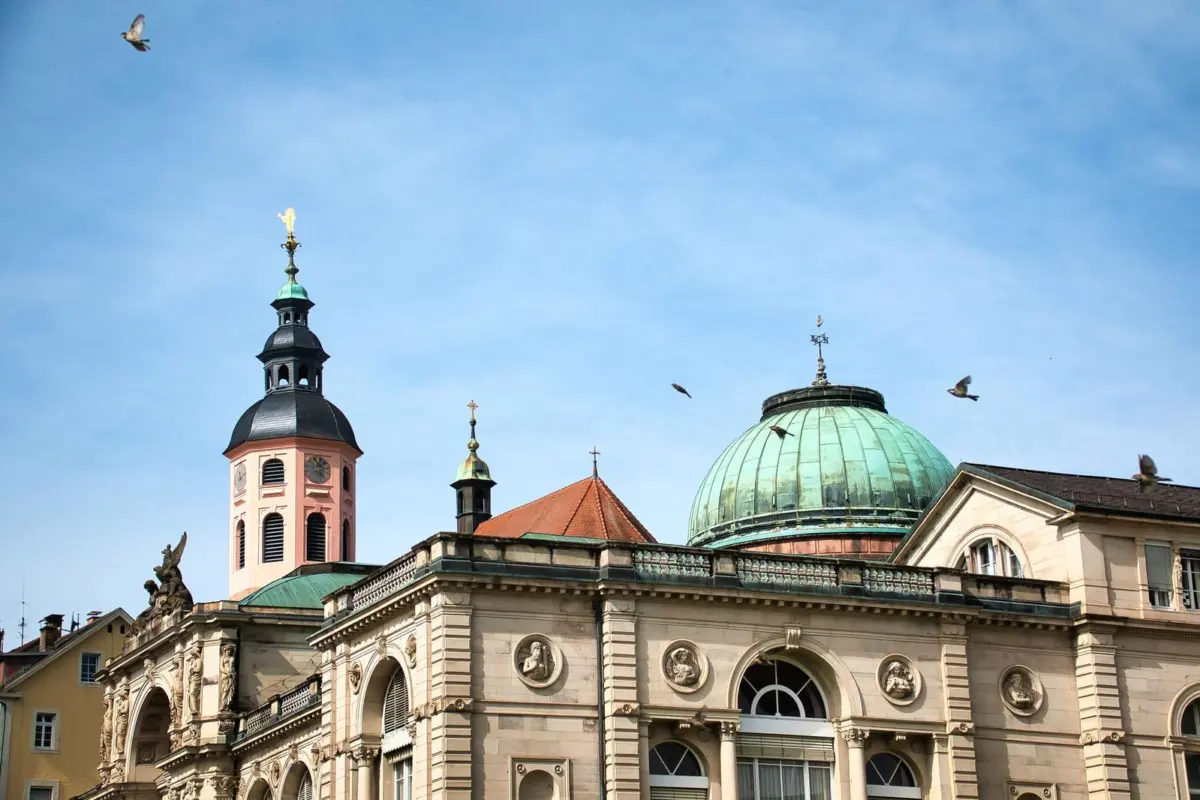
The Schwarzwaldportal describes the Friedrichsbad as a carefully planned ritual of 17 coordinated stations under a 54-metre-high dome. Insider’s Guide to Spas calls it a three-hour experience that ends with a swim beneath the dome.
National Geographic Traveller describes the glass-fronted Caracalla Therme as having 38C indoor and outdoor pools, aroma steam baths and saunas. The Schwarzwaldportal gives its size as over 4,000 square metres, and Insider’s Guide to Spas says swimwear is worn everywhere except the sauna.
The same Insider’s Guide to Spas feature mentions an indoor rock grotto with hot and cool water pools and a brine inhalation room at Caracalla, and says the outdoor pools are especially popular in winter. National Geographic Traveller describes the Friedrichsbad circuit as thermal baths, hammams and soap-brush massages, finishing with swims in a domed pool.
As a rule of thumb, choose the Friedrichsbad if you want the traditional bathing ritual in a historic building. Choose Caracalla Therme if you would rather swim, linger outdoors and keep your swimwear on.
The two guides describe the Friedrichsbad’s mixed-gender days differently. Confirm the current schedule with the operator before you go.
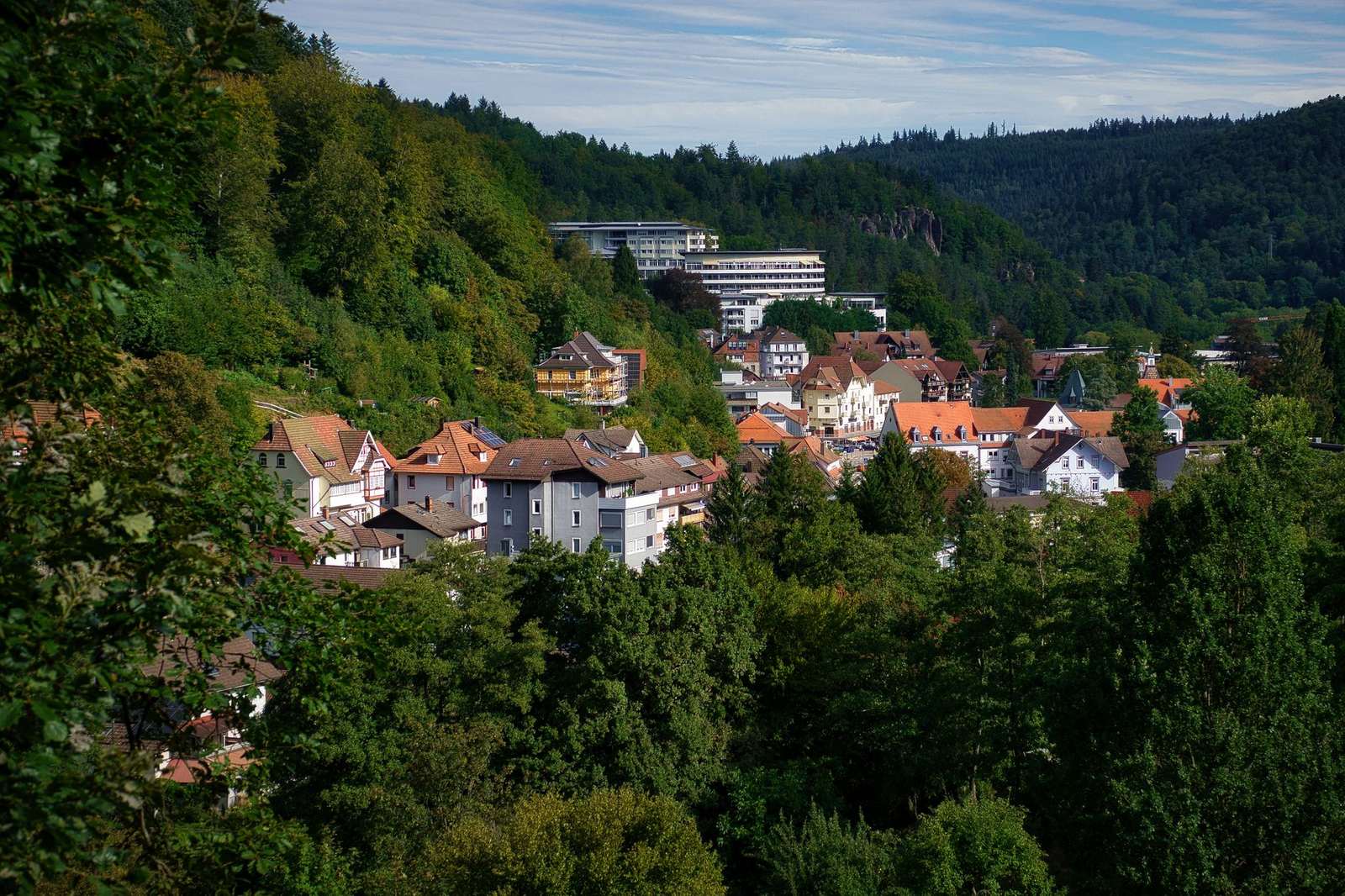
More to do around the baths
The spa is only part of the town. These stops sit close together or a short trip away:
- Trinkhalle and Kurhaus: National Geographic Traveller highlights the neoclassical pump room with a 90-metre-long Corinthian colonnade and the neighbouring Kurhaus casino.
- Lichtentaler Allee: a landscaped walk along the Oos River, and the site of the Museum Frieder Burda by architect Richard Meier, per the same article.
- Mount Merkur: a funicular, one of Germany’s longest, runs to the 668-metre summit, according to National Geographic Traveller.
- Hohenbaden ruins: the Schwarzwaldportal says the fortress was founded around 1100 and is now a freely accessible ruin.
- Panorama Trail: the same page describes a circular route of approx. 45 kilometres around the city, split into four daily stages.
After a day outdoors, a wine tavern is an easy dinner stop, and the guide to swabian food covers more of the region’s cooking.
Planning a day in town
A simple order works well for a first visit:
- Walk the old town early and visit the Stiftskirche.
- Look at the Roman Bath Ruins and fill a bottle at the Fettquelle.
- Spend the afternoon at the bath that suits you, Friedrichsbad or Caracalla Therme.
- End the evening on the Lichtentaler Allee or at the Kurhaus.
The town sits in the state of Baden-Württemberg on the western edge of the Black Forest, between Strasbourg and Karlsruhe. The dossier places the River Rhine and the French border 10 km to the west.
As of National Geographic Traveller’s June 2026 issue, Ryanair flights from Stansted to Karlsruhe Baden-Baden take 90 minutes. Routes, prices and opening hours change, so check with the airline and the baths directly.
A longer trip through the region could continue with freiburg im breisgau travel.
Frequently asked questions
How hot is the water in Baden-Baden?
Show answer
The dossier gives temperatures mostly between 56 and 68.8 °C at the springs. National Geographic Traveller says the pools at Caracalla Therme are 38 °C.
Can you drink the thermal water?
Show answer
Yes, at the Fettquelle fountain, which National Geographic Traveller suggests visiting with a bottle. The dossier describes the taste as mildly salty, getting stronger the hotter it is drunk.
Do you have to bathe nude at the Friedrichsbad?
Show answer
Both National Geographic Traveller and Insider’s Guide to Spas describe it as a nude spa, with mixed and separate days that they describe differently. Check the schedule first. At Caracalla Therme, swimwear is worn everywhere except the sauna.
Is Baden-Baden a UNESCO World Heritage Site?
Show answer
The Schwarzwaldportal describes it as a UNESCO World Heritage Site, part of the Great Spa Towns of Europe, since 2021.